
The European standards being developed to support implementation of the EU AI Act are moving towards a clearer and more coherent structure.
Following a CEN-CENELEC JTC 21 plenary decision and subsequent approval by the CEN-CENELEC Technical Boards (BTs), a number of the standards are moving to new numbers and titles.
This means that some familiar AI standardisation projects will increasingly appear under new references. But the change is more than a matter of numbering. The new structure also makes the relationship between the different standards easier to understand.
An architecture of interconnected standards
The AI Act is one regulation, but translating its requirements into technical and organisational practice requires a range of standards addressing different aspects of AI governance, development, deployment and conformity assessment.
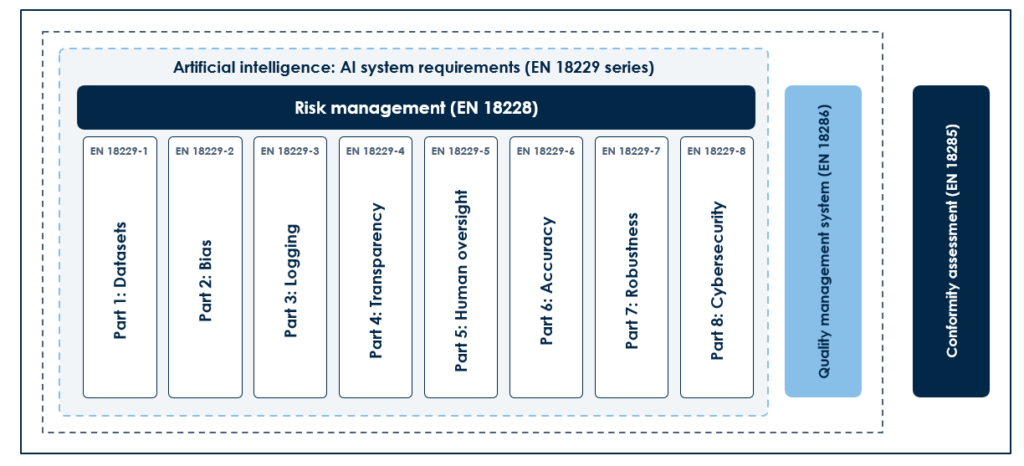
The illustration below shows how some of the central European AI standards fit together.
At the centre is the EN 18229 series on AI system requirements. The series brings together requirements addressing eight areas:
- EN 18229-1: Datasets
- EN 18229-2: Bias
- EN 18229-3: Logging
- EN 18229-4: Transparency
- EN 18229-5: Human oversight
- EN 18229-6: Accuracy
- EN 18229-7: Robustness
- EN 18229-8: Cybersecurity
These technical requirements sit within a broader standards architecture.
EN 18228 on AI risk management provides the overarching risk-management approach across the AI system requirements.
EN 18286 on AI quality management systems addresses the organisational and management-system framework.
EN 18285 on conformity assessment addresses how conformity with relevant requirements can be assessed.
More than a collection of individual standards
The structure illustrates an important characteristic of the European standardisation work supporting the AI Act: the standards cannot be considered only in isolation.
Risk management interacts with requirements for datasets, bias, transparency, human oversight, accuracy, robustness and cybersecurity. These technical requirements in turn need to connect with organisational processes and quality management, while conformity assessment needs to provide a means of assessing whether the applicable requirements have been fulfilled.
The challenge is therefore not simply to produce individual standards.
It is also to ensure consistent terminology, clear interfaces, coherent requirements, appropriate cross-references and well-defined relationships between the standards.
Seen from this perspective, the European AI standardisation work is developing an interconnected architecture in which different standards perform different, but complementary, functions.
One regulation, multiple standards
The restructuring and new numbering make this architecture increasingly visible.
The AI Act is one regulation. Its practical implementation requires multiple standards working together as a coherent system.
Understanding the relationship between those standards is therefore just as important as understanding the individual standards themselves.